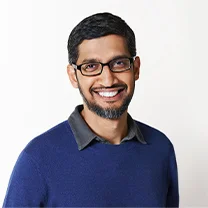
Sundar Pichai
CEO of Google and Alphabet
Sundar is the CEO of Google and Alphabet and serves on Alphabet’s Board of Directors. Under his leadership, Google has been focused on developing products and services, powered by the latest advances in AI, that offer help in moments big and small. Click here to explore more about Google services offered. During his speech at (AI Impact Summit) in India ; he talked about the following below.
Google CEO Sundar Pichai spoke to international leaders assembled at the AI Impact Summit in New Delhi, India. A transcript of the remarks as they were prepared for delivery is provided below.
Thank you, esteemed leaders and Prime Minister Modi. Being back in India is fantastic. I am often impressed by how quickly things are changing, and today is no exception.
When I was a student, I frequently traveled from Chennai to IIT Kharagpur the Coromandel Express train. We traveled through Visakhapatnam, or Vizag, on our way there. I recall it as a little, peaceful coastal city full of possibilities.
As part of our $15 billion infrastructure investment in India, Google is currently building a full-stack AI facility in that same city. When completed, this hub will host gigawatt-scale computation and a new international subsea cable gateway, giving people and businesses throughout India access to cutting-edge AI and jobs.
New Phase of Exploration(AI Impact Summit).
I never thought Vizag would become a global center for AI while I was riding the train.
I never would have thought that I would be working with teams to figure out how to launch data centers into space.
or driving my parents around San Francisco in a completely autonomous vehicle.
I had a completely different perspective on the advancement after witnessing a Waymo journey through the eyes of my 83-year-old father.
Naturally, he stated that he would be more impressed if it operated on India’s congested roads; we’re still working on that, Dad.
This advancement demonstrates what is achievable when people have lofty goals.
AI is the technology that has me dreaming the biggest.
The largest platform change in our lifetimes has occurred.
Hyperprogress and breakthrough discoveries that can help emerging economies overcome legacy gaps are just around the corner.
However, such result is not automatic nor assured. We must pursue AI with courage, approach it responsibly, and work through this pivotal moment as a team if we are to create AI that is genuinely beneficial for everyone.
Be audacious;
Why be daring?
Because AI has the potential to save billions of lives and resolve some of the most challenging scientific issues.
Predicting protein structures was a formidable task and a blind spot that impeded the development of new drugs for fifty years.
“How could we use AI to solve this?” was the bold challenge posed by Demis Hassabis and his team at Google DeepMind.
AlphaFold was the result of the inquiry. In addition to earning a Nobel Prize, this innovation condensed decades of research into a publicly accessible database. It is currently being used by more than three million researchers in more than 190 countries to combat antibiotic resistance, create malaria vaccines, and much more.
Isomorphic Labs is expanding this into drug research by using AI to rethink what it takes to produce life-saving medications more quickly.
From collecting DNA illness indicators to developing AI entities that genuinely collaborate with the scientific method, we are posing similarly audacious questions throughout the scientific stack.
When addressing issues in areas that have not had access to technology, we must be just as daring.
Consider El Salvador, where Google has collaborated with the government to provide thousands of people who could never afford to see a doctor with inexpensive, AI-powered diagnosis and treatment.
Or in India, where our collaboration is assisting farmers in safeguarding their means of subsistence during the monsoon season. Our Neural GCM model made it possible for the Indian government to provide millions of farmers AI-powered forecasts for the first time last summer.
Language inclusivity is another intriguing goal, in my opinion. We are working with academic institutions and non-governmental organizations in Ghana to expand research and open-source tools in over twenty African languages.
To address additional issues related to health, education, economic opportunity, and other areas, we need this audacious thinking in more places.
Be responsible (AI Impact Summit):
We need to make sure that everyone has access to the amazing advantages that technology offers.
We can’t let the digital gap turn into an AI divide.
This entails making investments in connectivity and compute infrastructure.
We have investments in Thailand, Malaysia, and other countries, as I indicated with regard to Vizag. As part of our America-India Connect Initiative, we are also constructing a massive network of undersea fiber optic cables, including four new systems between the United States and India.
Navigating significant economic changes is another aspect of responsibility. Unquestionably, AI will change the workforce by automating certain tasks, changing others, and generating completely new professions. Twenty years ago, there was no such thing as a professional “YouTube Creator”; today, there are over 60 million of them worldwide.
Training is essential. Our new Google AI Professional Certificate, which is available worldwide, will help people master AI in their careers. We have trained 100 million people in digital skills.
Lastly, the foundation of adoption is trust. To help confirm the legitimacy of the stuff you read and watch, we have developed tools like SynthID, which are utilized by journalists and citizen fact checkers worldwide.
Together, work through this moment.
But until we collaborate, we won’t be able to fully reap the benefits of AI, no matter how courageous or responsible we are.
The involvement of governments is crucial. This entails acting as regulators, establishing crucial guidelines, and managing significant hazards.
Additionally, as inventors, we are bringing AI to life-improving public services and speeding up the adoption of these technologies by individuals and companies.
Glimpses of this can be found all around the world:
The Ugandan government employs artificial intelligence (AI) and satellite photography to identify priority regions for electricity; in Memphis, Tennessee, AI scans of road surfaces from buses are used to more effectively fill potholes for locals. In order to help people realize their aspirations, tech businesses must also stand up and create tools that increase knowledge, creativity, and productivity.
Crucially, businesses of all sizes must consider this as well—using AI to innovate and improve their industries and businesses, as well as to empower and skill their employees.
We have a once-in-a-generation chance to make people’s lives better.
I am confident that we can accomplish this. I also think we have the will, based on the leaders here today.
Together, we must now complete the task.
I’m grateful